Saturday, April 9, 2011

Mask Creation

Inspiration Pieces

This mask obviously has form and shape as it is 3 dimensional.  The color of this mask is what originally drew me towards it. The hue is a beautiful pink at the just right intensity. All of the parts put together equal a whole therefore this mask has unity. It is also has variety by using the different lines, values and shapes. There is emphasis towards the eyes because of the darker coloring/shading. I picked this mask because I loved the use of the color pink and the unique design on the eyes.
Once again this mask is 3 dimensional so it has form and shape. The colors are what make this mask what is is by emphasizing the eye area. Once again there is unity due to the balance of each side of the mask. I picked this mask because I love the jewels used along the eyelids and the part covering the eyes.
This mask is simple but that is why it is so intriguing to me. It is 3 dimensional so form and shape can be seen. Line is used on this mask with the swirls drawn/painted on. Unity and balance can be seen through the use of the swirls being specifically placed on the masks. I picked this mask because it was simple and I loved the swirl design.

Sketches


Finished Product
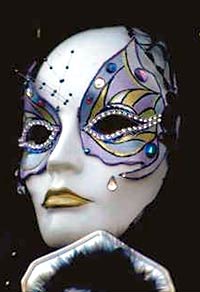
My finished mask has both form and shape because it is three dimensional. The shape is determined by the outer lining of the mask. I used a lot of color in my mask because I wanted it to be feminine and using "girly" colors such as purple and pink helped get that point across.  I also used one of the properties of color "value" by using light and dark versions of certain colors. Space is used in the structure of the face. The eyes and centered lips and nose give the mask a sense of balance. There are a variety of different colors and textures used in my mask.


Considering how terribly "un-artistic" I am, I was very pleased with the outcome of this mask. I thought it was a fun project and I really enjoyed getting to use my own interests. The "jewels" at the top form the letter J for my name, Jamie. I used my favorite color pink and made some "jewels" on the mask as well.

Friday, April 8, 2011

Week 11 Video Reviews

1. Explain why you selected each of the FOUR videos you choose from the selection listed above.
2. For each video list/discuss the key concepts you learned.
2. How do the videos relate to the readings in the text?
3. What is your opinion of the films? How do they add depth to understanding of the readings and art concepts?

Buddhism
1. I chose to watch Buddhism first because while doing the discussion forums I was really intrigued by Buddhism and couldn't wait to learn more about it.
2. Buddhism began in India. The prince had everything and one day stepped into the real world and saw suffering, wasting and death. His perfect work was crushed and a monk answered all of his questions. He craved contentment and meditated. He opened his eyes and saw the world differently. That is when Buddhism was born.  His basic message was love. Bodh Gaya is sacred to Buddhists. After Buddha died, Buddhism divided into two different groups, hinayana and mahayana. There is a monastery in Carmel, New York. There are many buildings dedicated to Buddhism. Buddhism is full of paradoxes. For instance it is flourishing in all Asian countries except one, India where it began.
3. Buddhism is discussed on page 424. The text references Gautama the prince as well as the beliefs that time is cyclical and all beings are condemned to suffer an endless series of lives. The book talks more about the artist aspects of the religion while the video talked more about the religion itself.
4. I really enjoyed the film. Buddhism really interested me after reading about it in the text so I was excited to watch this video. It added to my knowledge of the religion itself, not so much the art piece of it all. The best part was the end when it talked about how it was full of paradoxes.

Hinduism
1. I often hear of Hinduism but don't really know anything about it. I thought it would benefit me to watch these videos and gain a greater understanding of the religion.
2. Varanasi is the holiest city in India. The Ganges river is a symbol of death and reincarnation. Hinduism believes life is for millions and billions of years because of life, death and rebirth Hindus can worship anywhere. Aarti is a Hindu ceremony that means "removal of pain". Shrines are a large part of Hinduism that are carved from boulders. 9th century a temple was created. There are exotic treasure found all around the temple which made it famous. Kama Sutra is from Hindu. Brahma gave life to everyone so sex is applauded in this religion.
3. Hinduism is talked about on page 428. The text also refers to Brahma and the Kandariya Mahadeva temple.
4. Seeing the picture in the book does not do the temple justice. It was amazing to see the amount of intricate detail that went into created the decorations of that temple.

Chinese Art
1. Honestly there really wasn't any specific reason for choosing this video.  The title about treasure caught my eye.
2. A lot of art from the museum was shown in this video. The chicken bowl was interesting because you don't often see color being used that that on a cup or bowl in America. Seeing the perfumer was the first time I have ever heard of something like that. They talked about the patterning and intricate detail that went into making it. The goblet that was shown showed how the curves were included for both practical and artistic reasons. The crosses are found no a lot of early bronze works.
3. The text refers to Chinese art on page 432. It talks about the Formative period, Confucianism and Daoism  as well as Buddhism and landscape painting
4. This video was a little long and didn't keep my attention as well as the others. It got into a lot more in depth parts of Chinese art that added to my knowledge base of the subject.

African Art
1. Once again, no real reason for choosing this video. I just specifically remember reading about it in the text.
2. Hairstyles, rituals, and performances were the ways in which art was shown. Art is very important to them and they like to show it through dancing. The different concepts of African art are color, sound and movement.
3. The text refers to African Art on page 413. It refers to sculptures with the D shaped eyes, the Nok culture, the Benin culture, the Yoruba, and Dogon.
4. I never knew that Picasso was inspired by African masks and sculptures. That was really interesting to me. It also talked about the historical parts of it which the book didn't really mention. The video was okay, but nothing can beat the first video I watched, Buddhism.

Friday, March 25, 2011

Video Review

1. Explain why you selected each of the FOUR videos you choose from the selection listed above?

I selected the drawings of Michelangelo because I have heard about Michelangelo a lot and even read about him in the text but can't really think of any of his work.

I chose Leonardo da Vinci: The Mind of Renaissance for a similar reason. I knew of him to be a great artist but  I was unsure why.

I chose Velasquez because it is something I have never heard of and I thought it would be interesting to learn about.

I chose La Primavera (Botticelli) because the artist's name looked so familiar but I couldn't figure out why.


2. For each video list/discuss the key concepts you learned.
Drawings of Michelangelo: Michelangelo created many Christianity pieces and works of art involving the human figure. His sculpture work was self-taught and he had vast knowledge of human anatomy and used volume and mass in his works. He would discard works that he was not happy with because he was a perfectionist. Many artists try to replicate his cross hatching techniques.
 
Leonardo da Vinci: Da Vinci was an artist of proportion and perspective. He was the definition of being a "Renaissance Man". The video talked about his entire life and how he was always considered extremely smart. It was very interesting to learn that he was one of the first people to perform dissections.

La Primavera: Botticelli liked to use drapery in his artwork when working with females. The work discussed are very controversial. His work was interpreted as religious, symbolic and/or homosexual. His media (paint) was also discussed.

Velasquez: Velasquez was an artist who created works of art for King Philip the 4th. He was interested in the emotions of the royals as well as Greek mythology.

3. How do the videos relate to the readings in the text?

Drawings of Michelangelo: The text specifically mentions Michelangelo and it also talks a lot about the Renaissance time period which was also mentioned in the video.


Da Vinci: The text and the video both talk about the Renaissance and the fact that Da Vinci was a "Renaissance Man".


La Primivera: The video and text both talk about Botticelli, humanism and neo-platoism art.


4. What is your opinion of the films? How do they add depth to understanding of the readings and art concepts?
I thought the films were interesting but too long. It was hard for me to keep focused for that long even though I was very interested in learning new things. They gave further insight into what the text already told us about the Renaissance time period/style as well as specific artists.

Wednesday, March 23, 2011

Exploring Line


1. What was it like using your hand as subject matter for a drawing?
Using my hand as a subject matter was interesting. At first I thought it would be very easy because a hand is a hand, there's no need for further explanation or insight. It is what it is. I didn't realize until I was adding to my drawing how much detail my hand has. There are many tiny, specific lines that are all spaced and placed in a unique way.

2. What media did you select - pencil or charcoal? Why?
I chose to use pencil because I knew I would need to erase quite frequently. Also because I wanted to use something I am familiar with. 
3. How did it feel to create a drawing with your non-dominant hand?
It was very difficult to create a drawing with my non-dominant hand. It felt foreign and I became frustrated easily.
4. Compare and contrast your final drawings. Do you think they are successful studies?
The drawing of my left hand looks more realistic than my right. The lines in my right hand appear more jagged and awkwardly placed than the lines in my left hand.

5. Would you consider using your non-dominant hand to create artwork in the future?
 No, I would never use my non-dominant hand to create artwork in the future unless I would trying to recreate a child's work of art.


Friday, March 11, 2011

Video Review 2

Prairie Style was about how Frank Lloyd Wright changed architecture in America by reconnecting us with nature. The video showed us his prairie house designs and his idea of organic structure. The book talked about organic structure and more specifically Frank Lloyd Wright. I was surprised that he did not finish high school. I wasn't really expecting that because he seems so intelligent. I enjoyed this video because I liked looking at the houses they showed us.

The Science of Technology video showed the use of technology with architecture. It built on the ideas the book brought up about artists choosing different materials and structures depending on the environment and location. The book also talked about using concrete in Roman and Greek architecture which the video mentioned. Science is my least favorite subject so this video was not my favorite. It was interesting to learn about the science behind architecture because I have never really thought about it before.

The Classical Architecture video talked about how classical architecture is still used today, for example, "Renaissance Architecture". The video talked about solar panels which relates to what the book says about Green Architecture. Also relating to the book was the discussion of the Greek and Roman architecture. This video was pretty interesting and I learned a lot of new things about architecture then and now.

I chose to watch the video Last Call for Planet Earth. It was really intriguing when the first architect said going green in architecture is "a matter of survival". This video directly relates to the book when they talked about Green Architecture. I liked this film because it gave me even further insight into the concept of Green Architecture and how important it really is. I chose this film because I felt like I already knew enough about architecture in art from the book and other videos so I didn't need to watch Architecture in Art. I didn't choose Mathematics in architecture because I am terrible at math and it doesn't interest me at all. I chose Last Call for Planet Earth instead of Ancient Architecture because of the grabbing title and it seemed like a more recent video.

Sunday, March 6, 2011

Installation Art


 Artist: Jamie Milligan
Title: Homecoming
Media: Installation
Date: 3/6/11
Description: I see a staircase, 2 combat boots, a military jacket and some dog tags.
Formal Analysis: Color is used with the green jacket. The color of the carpeting and the boots are all neutral colors so it makes the green army colors stand out. Form is also used by the use of the staircase.

What are your thoughts on the planning and creation of a site specific location?
I really like the way this turned out. It is simple but at the same time is says a lot. The location was my first thought so I just had to decide what I was going to put on the staircase that would tell a story. The military things make this picture what it is.

Reflect:
What is installation art: It is art in which a space is presented as work of art that can be entered, explored, experienced, and reflected upon.
What materials are used in installation art: Anything can be used in installation art as long as the artist finds it to be artistic in some way.
Why make installation art: Installation art is created to evoke feelings and emotions from the viewer by changing the space in a room.
Which artist/installation did I find most interesting: I like the installation titled Mantle. It is on pg. 47 and was created by Ann Hamilton. Looking at the picture is interesting but when you read about it, it says that there are speakers in the flowers the broadcast the confusion of voices and static while a woman sews sleeves seemingly unaware of the flowers and noise. This is intriguing to me and would be very interesting to see in person.

Plan
From the material reviewed, is there a inspiration piece that I feel a connection with: I was inspired by Ann Hamilton's Mantle. I like how when you saw this Mantle you felt like you were part of it in the present time. In a very, very unique way there is a story being told with this installation.
What theme do I want to explore in my installation: "The Here and Now" will be the theme I am going to use.
What materials will I use: I will use my husband's military uniform things.
Where will this installation be located and why? I am going to create my installation on the staircase. It will create a story with the uniform items laying on the stairs.

Friday, March 4, 2011

Video Review

1. In "Through the Eyes of a Sculpture" I learned that making a sculpture is a long, painstaking process. It requires time, patience and planning from beginning to the end. The sculpture usually starts with a sketch, then they make it with clay, and then a plaster cast. There is a lot of research that goes into these sculptures, it's not like the artist just threw something together or picked an idea out of a hat.

In "In Glass and Ceramics" I thought it was interesting to learn that ceramic materials can be stronger than steel. This kind of art correlates with the field of science. I never knew that glass is a type of liquid composed of silicon dioxide or sand. Essentially, the medium of glass is not restricted to the artist, but is a field of scientific development.

"Installation Art" taught me that it is any 3-d artwork that defines the space and forces the viewer to interact with it. Anything can be art depending on how the viewer is looking at it.

2. Like the videos, our readings discuss sculptures, ceramics or crafts, and installation art. However, the videos add a little more understanding of these topics because they go into more detail. The videos also show examples of things the book talks about.

3. My favorite video was the "Installation Art" video. It really gave me a lot more insight to what it really is. It also gave me inspiration and some ideas for the project. "Through the Eyes of the Sculptor" made me appreciate sculpture a lot more. I never realized how much more work goes into a sculpture. "In Glass and Ceramics" was my least favorite because it had to do with science. It broadened my horizons but was not very interesting to me.